Beckett Photographing
Samuel Beckett was critic and poet, patron for many visual artists, and experimented with film and television. This study explores specifically the photographic elements of his work, an important relationship largely undeveloped (unlike the excellent work done on the painterly in Beckett) that illustrates the great potential for collaboration between literary criticism and photography.
The texts of Samuel Beckett lend themselves naturally to this kind of interdisciplinary work. Beckett himself was a pioneer of the interdisciplinary arts, merging critic, poet, novelist, playwright, filmmaker, and choreographer into one. The final tableaus of Beckett’s plays, the cropping of bodies and body parts, the opposition of darkness and light, and the insistence on the subjective I in his prose––all these traits of his writing share in the basic nature of photography. But more centrally, photographs mirror the problematic nature of representation in Beckett. The truth of photographs, like the ability of language to express, is taken for granted. Reexamined, photographs and words reveal uncertainty and subjectivity, where previously unexpected.
In many of his pieces, Beckett neglects the established rules of the medium. Instead, he applies the rules of another. Text is approached as an image, and image as a text. This act of pseudomorphosis––that is, approaching one medium with the aesthetics of another––is key to Beckett’s work and undermines even the most basic understanding of words and images, that being words speak and images literally do not. The later prose successfully reverses Simonides’s dictum that ‘poetry is speaking painting and painting silent poetry.’ In a transposition of words, poetry in Beckett is silent painting and his still images speak (like poetry). The attributes of painting and poetry taken for granted in Simonides’s dictum have been denied: poetry itself goes mute, and painting, so long silent, begins to speak on its own. Daniel Albright phrases this reversal of speaking and silence in terms of motion and stillness in Beckett’s late prose. “[P]ictures turn into animated cartoons,” he writes, “while fictions develop the dead immobility of pictures.”
In Beckett’s texts, the imagery conjured by the words is a single photographic image, a two-dimensional still snapshot, not a painting and never an animation. Krapp’s celebrated description of his vision on the jetty typifies the stillness emblematic of the Beckettian image: “that memorable night…at the end of the jetty…when suddenly I saw the whole thing. The vision at last.” The sudden, whole vision appears all at once in a flash, like a photo that freezes even “the foam flying up in the light.” These kinds of pictures appear in all of Beckett’s texts, often infused with much more narrative and figurative symbolism than the words themselves. The words, on the other hand, often evoke a palpable and still silence, contradictory to the fact that the reader must pronounce them in time.
In Beckett’s 1981 prose piece Ill Seen Ill Said, for example, unassumingly stark language and repetitive near-still action contrast the dynamic images. Always fading and reemerging, enveloping the character and losing her, the image takes over the central active role of text. Though the words are paradoxically silent, the images fill the silence, not with sound, but with meaning and potential action. The image hangs in the imagination, like a moment captured on film—frozen forever, endlessly signifying, and always ready to spring into motion.
Throughout his career, Beckett changed the rules for creation. He highlighted image in text and signification in images, used still shots in a motion picture, and wrote a play for no actors. Often mistaken by critics for ‘negation’ (of life, of art, of hope), Beckett’s use of pseudomorphosis negates only the established tenets of specific artistic media, thus opening the medium to new uses. By addressing one medium in the guise of another, Beckett and his texts encourage the audience to likewise readjust their own methods of reading.
This abandonment of standardized creation parallels and informs a more general movement occurring in the mid- to late-twentieth century to approach art with the eye of a critic and criticism with artistic flair. The rise of conceptual art in the sixties and seventies suggested the artist’s visual creation to be of equal importance to his related critical writings. Likewise, critical and theoretical writers began to explore more poetic language. The fact that each of the arts, especially photography in its painterly approach and theory in its use of poetry, began using the methods of other disciplines shows that Beckett’s experimental and sometimes troubling fusion of media reflects a more universal redistribution of power and procedure among the many arts.
The more shades of criticism shone onto a work, the more shades of the work will be revealed. Interdisciplinary criticism, like literary criticism informed by the visual arts, can illuminate darker meanings than the critic with only one tool, especially when the subject is an interdisciplinary artist, like Samuel Beckett. There is a photographic quality in the work of Samuel Beckett and the tool to find it is a camera as well as a pen.
This interdisciplinary study aligns itself with Beckett’s aesthetic and critical approaches to art as well as reasserting the experimental context in which he worked. By including my own photographs (“Photographing Beckett”), I redirect critical pseudomorphosis back onto Beckett’s work, using images as a mode of textual interpretation.
In adopting a critical approach based on a logic inherent to the text, literary analysis serves the text on its own terms, rather than projecting onto it the narrative of the analyst. Pseudomorphosis in criticism, then, is not only an exercise appropriate to an author like Beckett but also an overlooked mode of interpretation that can unveil aspects of a text that the ‘neat identifications’ of strictly linguistic analyses cannot.
Beckett’s approach to criticism in his own early critical works Dante… Bruno. Vico.. Joyce and Proust informs the series of photographs created for this essay. As a critic, Beckett avoided “complete identification” between the critic’s abstract and the artist’s text. Instead of uniting critical work (the essay) and creative work (the text) relatively, he lets each side exist absolutely, allowing the critic’s ideas and the text’s to relate as wholes. Thus, the images I present do not illustrate exactly or interpret completely, but rather present a separate absolute to act as a foil for multiple interpretations of the text.
The building blocks of text and image
Far from Lessing’s original conception of poetry and painting as separate but equal, Samuel Beckett’s approach instead unites the two from the bottom up. In his unprejudiced choice of media, switching from the pure image of film and mime to immaterial words of radio plays we see exchange rather than isolation. Beckett links language inextricably with the visual, leaving painting and poetry equal, but not separate. In fact, their conceptual proximity manifests itself in material synchronicity. Literary theorists agree, the smallest coherent unit of language consists of the word. In photography, the smallest unit is a photon of light. The interdependence of words and light, the building blocks of text and image, illustrate the close relationship of texts and photographic images.
Though the association of silence with darkness seems to be a basic assumption, the alliance of words with light is a less evident one. The pairing of light and words, the building blocks of image and text, acts as a microcosm for the relationship to be established between the visual and the textual throughout the work.
Beckett shows that, regardless of his thoughts on the relationship between literature and the arts, in the world of his texts these most basic components are always found together and accompany each other in an insistent way.
The technical aspects of the 1963 play entitled Play are based on this alliance. A spotlight dictates every word spoken by the characters (“speech is provoked by a spotlight,” he writes in the note). Even the volume of speech corresponds proportionally to the strength of the illumination.
In Company, written 17 years later, the union continues: "By the voice a faint light is shed. Dark lightens while it sounds. Deepens when it ebbs. Lightens with flow back to faint full. Is whole again when it ceases." ("La voix émet une lueur. Le noir s’éclaircit le temps qu’elle parle. S’épaissit quand elle reflue. S’éclaircit quand elle revient à son fabile maximum. Se rétablit quand elle se tait.") While in Play the voice is a consequence of the light (“provoked by the light” / “extorquée par la lumière” ) and in Company the light is a consequence of the voice (“la voix émet une lueur”), the two function in unison. “The response to light is immediate,” the stage directions for Play read. Though one precedes the other in theory, the image and language act in unison, appearing to the eye and the ear simultaneously. In Company, especially in the parallel phrases of the French version (“S’épaissit quand…S’éclaircit quand…Se rétablit quand”), the voice and its light ebb and flow in unison as dancers that move seamlessly together though one leads and the other follows.
One can thus assume that because they are connected at the root through word and light, text and image are linked as well. In some cases the image generates the text, as in the careful description of a scene imagined by the author or a mysterious tableau that begs for resolution, in which case the viewer produces her own text. More commonly, the text captures an image, using words to construct, destruct, and manipulate a scene over time. In both ways, visual and verbal are company on the most basic level, and so too at levels more complex.
Failure to Represent: Ill Seeing and Ill Saying
Known by many as a ‘poet of impossibility,’ Beckett challenges the artist to express within the constraints of a faulty medium. A more appropriate title would be ‘poet of the impossible medium,’ since the burden of failure “lies not with Beckett the particular artist but with art itself.” Some critics take him for the source of impossibility in literature, as if he wrote it into existence, when in fact ‘impossibility’ originates in language itself. Beckett highlights the impossibility of complete representation which stands between him and poetry.
Realizing the arbitrary nature of the sign, Beckett reveals the whole mechanism to be a kind of linguistic magic act, convincing but logically impossible. Clever magician in one moment, skeptical heckler in the next, the narrator of the Beckett text pulls language out of a hat then mentions the trapdoor in the table. Whereas traditional narrators rely on logical progression in time and space, the Beckett narrator, like the magician, relies on sight. Beckett’s work uses visualizations to destabilize language in the same way Saussure did when he visually separated the signifier and the signified.
Beckett’s distrust of language likens his aesthetic to a visual and specifically photographic sensibility. The photograph is dual in that it is both signifier and signified. The photograph is also contradictory in that the signified is absent in the face of the signifier. “The magic power of images,” Vilém Flusser writes in his book on photography, “lies in their superficial nature and the dialectic inherent in them.” Photographs, more than any other pictorial form, challenge the conventional notion of representation most clearly for they do so both on the surface of the image and in the problematic relationship to a ‘real life’ subject. “The willingness to display the struggle,” McMillan writes, “is itself a form of honesty that Beckett has admired in contemporary visual artists and that places him in their tradition.” Photography embodies the struggle between an image and its referent, the signifier and signified, the same struggle that occurs in Beckett’s work.
The presence of a sign without a referent makes photography hinge on the question of absence. Flusser reminds viewers, “it is wrong to look for ‘frozen events’ in images,” because the event doesn’t exist there. Roland Barthes addresses the centrality of absence in La Chambre claire, which has since influenced its centrality in much of contemporary photographic theory. Showing photographs to someone, we usually say something like, “Look, this is my brother,” or “See, here I am,” speaking of the referent in present tense. For Barthes this intimacy highlights absence; the initial “Here it is” inevitably changes to “That has been.”
Beckett’s texts too function by a logic of absence. He once suggested that if he were to write a critical piece on his own texts, he would start with a quotation from Democritus, “Nothing is more real than nothing.” Rightly so, nothing is more present than absence when addressing the link between signifier and signified in Beckett’s prose. For example, in Worstward Ho the text contains words whose referents, according to the narrator, do not even properly exist.
"It stands. What? Yes. Say it stands. Had to up in the end and stand. Say bones. No bones but say bones. Say ground. No ground but say ground."
Beckett’s narrator presents a schism between the reality from which the words are drawn and their linguistic existence. There is no ground but you must still say it. The narrator says, “It stands,” without knowing what “it” signifies, if it signifies anything. He then asks, “What?” to which no answer can be given. Language exists as if in its own dimension, where not even the simplest pronoun has a referent. Similarly, though the reader understands the referent of the words “bones” and “ground” more clearly than “it,” he may as well not, since there are “no bones” and “no ground” present anyway. To “say bones” does not conjure physical bones into material presence. Rather, the word “bones” begins to exist of its own accord, separate from its absent referent.
The repeated “say,” sounds like the French “c’est,” which reinforces the finality of the signifier as signified: the signifier “is.” “No bones, but it is bones,” the phrase would read. Even though there are no physical bones as referent, the word “bones” as sign is present. Language, therefore, like a photograph, can present a sign without signifying any referent at all.
In the first act of Happy Days Winnie is buried up to her waist in sand. In the second, the sand is up to her neck. “And should one day the earth cover my breasts, then I shall never have seen my breasts, no one ever seen my breasts,” Winnie says in Act One. The statement, “I shall never have seen my breasts,” negates all the past instances on which she has seen them. We see that Winnie uses the same philosophy of absence as in Worstward Ho. She uses a visual logic for existence so that the day her breasts cease to exist visually, they cease to exist referentially. The image dictates the logic of Beckett’s world to such an extent that the existence of a concept is denied by its physical absence, as if each play and each prose piece were a framed image with a limited and limiting visual vocabulary.
Beckett returns to Saussure’s definition of the linguistic sign as signifier and signified occupying two halves of a circle. The one hastens towards the other, but ultimately they remain physically discrete. Saussure prefaces his discussion with the reminder that it is “[anything but true] that the linking of a name and a thing is a very simple operation.” This Beckett clearly demonstrates, challenging even the reader to reevaluate his process of linking words with their referents.
Ill Seen Ill Said challenges the ability of language to signify something ‘ill seen’ in the mind. The sentences are short and the text hesitates to articulate even at the level of the word. “[W]hat is the wrong word,” the narrator repeats throughout the piece. This interjected cadence is seemingly an attempt to call to mind what anyone else would call the ‘right word.’ In replacing the silent mental search for the Flaubertian mot juste with an outwardly-spoken loss for the “wrong word,” Beckett rejects even the possibility of a right word. In questioning the ability of the medium to do what it’s expected—namely, to present one with the right word—Beckett shifts the goal of language away from representation (since the right word for what he’s trying to say doesn’t exist) and back to simply presentation.
The narrator does not apathetically deny the existence of the right word. Actually, the narrator of Ill Seen Ill Said does not settle for just any wrong word, he searches for it in all its specificity: it is the wrong word. In the French Mal Vu Mal Dit, the wrong word cadence reads, “comment mal dire.” This phrase of course resonates with the title more closely than the English, and it presents the narrator with the question not just of ‘how to say it’ (comment dire) but, by adding that modifier, how to say it in a specific way. In both versions, ‘wrong’ or ‘mal’ modifies a popular expression (‘what is the word’ or ‘comment dire’), replacing the typical modifier, ‘right’ or ‘bien,’ denoting clearly the vigilance with which one must fail. “Try again. Fail again. Fail better,” runs a line from Worstward Ho. Here every word is a wrong word and everything said, ill said. Some words, however, are just more wrong than others.
Rather than working to find the perfect signifier to express what is signified, Beckett divorces the pair. He rejects reliable signification beyond the word by questioning its very ability to signify beyond the page. Beckett’s understanding of language assumes that the visual absence of a referent within the space suggested by the text (that place where there are no bones nor ground) cancels out the signification of the word. Thus, the rules of language change constantly depending on the presence of a referent. This conception at once separates the signifier from its dependence on the signified as well as integrating the two completely, as with the trickery of a photograph’s simultaneous sign and “present” referent.

My photo series “Faire l’image” visualizes the struggle to represent using such questionable systems of signs by documenting the painstaking construction of an image. This series takes its title from Beckett’s 1959 prose piece, L’image. A sort of painting in motion described in one short unpunctuated rush, the piece ends “c’est fait j’ai fait l’image.” With l’image faite, the sentence ends, having no further goal than to make the image. The construction of images here directly parallels the construction of a text.
Let us examine the series. Beginning with a place, dark except for the dim light coming from a window, and the light from it reflected in a mirror on the right, the photographs build a scene piece by piece. With each new photograph, the light in the room grows and the space becomes more defined. The light, as we have already seen, is the voice. This opening scene with the light coming into the darkness therefore visualizes the very beginning of Company: “A voice comes to one in the dark.” “A voice,”––a light, the first photograph––“comes to one,”––a chair stands in for the “one” in the second image, then a figure, perhaps the narrator appears, but is then replaced again with a surrogate, here they are stones in the fourth image––“in the dark.” The different physical permutations of the “one in the dark” (chair, figure, stones) parallel the continual shifts of listener and speaker identity in Company. The voice, at once the narrator and the listener, comes from the one who “devises it all.” In the same way, the photographer creating the image at first only coyly shows herself, first erecting a tree (sixth), then darkly glimpsed in a mirror (seventh), always hidden in the scene. By the end, though, as in Company, the images grow more reflexive, the mirrors more reflective, and the creator presents herself fully, only slightly blurred. From the very start, the images and the text address manipulation. The presence of two windows, one real and one reflected, suggests stereoscopic vision as if the windows were two crooked eyes looking out onto the world. The artifice of this stereoscope hearkens back to the magic of perspective. Though initially convincing, the false reflection should announce itself to the viewer. The images present the typically photographic monoscopic view of art—the camera’s one-eyed lens capturing incomplete reflection mirrors the signifier’s stilted correlation with its signified. As the scenes progress, the camera appears multiplied in the mirror, the number of lights (of voices) grows, and the narrator, the deviser of it all presents herself to the eye of the camera. In the last photograph the photographer shows not her face or eyes but her hands, with which she has manipulated the scene, the text. She, like the narrator of Company takes a bow, acknowledging her deceptive work: “bow down your head till it can bow down no further. But with face upturned for good labor in vain at your fable.” The space defined, the image made, and the game played, the narrator appears again as she first presented herself in image three: “And you as you always were. / Alone.”
The visual and linguistic struggle, between the author, his work, and his words plays out in many texts. “Faire l’image” applies to more pieces than Company alone; in fact, I didn’t even conceive of the project with Company specifically in mind. Made rather in the general polymorphic vein of Beckett’s textual sensibility, the series, in its lack of linguistic specificity acts as a model through which to view multiple texts and concepts. The images are arranged as they are; it is the work of the critic and the reader to continue to improvise on this line of images.
For example, “Faire l’image” could also call to mind a play. In Endgame, Hamm verbally conjures lush natural scenes that starkly contrast the bleak two-windowed interior of the space centered around his throne-like chair. Relating these critical images to plays and films, media already rich in visuals, illuminates more than a simple rephotographing preexisting Beckett images. The chair covered with a white sheet (photograph ten) recalls Hamm’s position at the opening of Endgame, seated and draped before Clov unveils him. The photographs contain more than mere duplicate scenes; they visually weave the text of the play into the given image. Hamm’s dreams materialize piece by piece, branch by branch. “If I could sleep…” he muses to himself, “I’d go into the woods. … Nature! [Pause] There’s something dripping in my head. [Pause] A heart, a heart in my head.” The impossible work of transforming an attic into a forest by piecing together twigs and branches heightens the hopelessness of Hamm’s own voyage into a distant forest. His words appropriate the space, transforming it into a makeshift mental landscape, the scenery we might find inside a skull. Thus the likeness in image rather than language motivates the illogical narrative transition from the woods and nature to what is “in [his] head.” Here, the two combine physically to form an image than illustrates the logic Hamm’s words.
In a study of a few of the specialty artist books made to accompany Beckett texts, Judith Weschler addresses the important interpretive role of images. “Illustrations are a form of hermeneutic: concerned with interpretation, their view is partial and uncritical, unlike exegesis or practical exposition. … The imagery need not be the same as that of the text but should have the qualities of fragmentation, paradox, and irony.” Though I would disagree with her suggestion that exegesis is impartial and partiality uncritical, I certainly agree with Weschler’s understanding of images as a hermeneutic. The images I present, unlike illustrations, do not accompany Beckett’s texts. They do however feature fragmentation, paradox, and irony while at the same time acting as a form of criticism. Photographs accompany criticism here and each following three sections of this argument has a corresponding set of images to illustrate not the text but a theory of the text. The images highlight relationships, themes, and formal elements common in many of Beckett’s texts without needing to verbally name every element in the picture as it applies to each individual text.
Perception: The eye that sees but is not human
Beckett’s engagement with technology in his experimental work with radio, sound recording, television, and film, laid the groundwork for an interdisciplinary approach to the arts and facilitated a discourse around machines of reproduction (camera, tape recorder) that now dominates post-modern art theory. The use of audio/visual devices not only as equipment but also as metaphor informs plays and prose alike. Even his prose implicitly proposes theories of photography. The photographic eye, a cycloptic entity, distinctly different and “other” than the “eye of flesh,” perceives every movement of the central character from as many angles as possible.
The most literal fusion of the perceiving eye with the camera occurs in the 1965 film Film, which presents a philosophy of photography linked closely with the self-perception. Film personifies the eye as a camera angle, shot from eye-level that tracks the main character from behind and also as a character referred to in the script as “Eye” (the other character being “Object”), a fragmentation of the character’s ego. Buster Keaton, who plays Object (and Eye when finally revealed), flees the vision of the camera Eye, as well as every other eye he encounters (neighbors, pets, anthropomorphosed envelopes, and eyes reproduced in photographs) in an attempt to escape perception. As the viewer sees only the frames viewed by the Eye, that is, the camera (in addition to a few point-of-view shots from Object’s perspective), he never sees the face of the fleeing Keaton until the end of the film. When the camera Eye finally corners the Object into a head-on view, the audience sees for the first time that Keaton wears an eye patch, which morphs him into a physical embodiment of the monoscopic camera. In the clear almost heavy-handed gesture of giving Object only one eye, Beckett addresses perception and self-perception as inextricably linked with the lens of the camera itself.
The perceiving eye in Beckett though is usually divorced from a specific human seer and photography perceives space distinctly different than human eyes do. One crucial difference between human lenses and a photographic lens is stereoscopic and monoscopic vision––two lenses versus one. The parallax between our two eyes allows us to perceive the world in three dimensions, whereas Keaton, like the camera, sees only in two. Despite the fact that the camera’s optics and aspect ratio derive from human vision, the photographer’s one lens is not equivalent to our two. The classical tradition in visual representation, attempts to overcome the difference by using perspective to trick the eye into seeing stereoscopically. Trained for centuries in the tradition established by Renaissance painters, most viewers see photographs too as a “transparent plane, a ‘window’ leading beyond the painting” rather than a world of signs on paper. The dominance of perspective and of realistic representation in the visual arts recalls the linguistic act of simply associating a word with its referent, without accounting for the complexity of the signifier-signified relationship.
While one could at first see the eye as belonging to the gaze of the audience, more closely examined, these scenarios present instead the eye of an outside perceiver, or sometimes the duplicated eye of the character himself. Even though the plays frequently toy with the idea of the traversed fourth wall, the eyes of the audience can be eliminated from this discussion since they are always plural, stereoscopic, while the eye of the camera-entity is singular. Clov in Endgame peers out at the audience through his magnifier and describes seeing “multitudes [plural] in transports of joy.” Winnie too speaks of perceiving eyes: “Someone is looking at me still. … Eyes on my eyes.” These lines refer to the audience, but the eye described in prose like Ill Seen Ill Said does not view the protagonist from human heights or with human parallax. The singular eye sees the character everywhere she goes, from near and far and all different angles. The eye is always singular, like the monoscopic camera eye that identifies perspective in art.
In her critical work on Beckett, The Broken Window, Jane Alison Hale indirectly discusses the mobility of the camera, opposing it to the stability of Renaissance painting: "In [Beckett’s] works, human beings no longer occupy a stable and privileged point in space and time from which they may visually organize, give meaning to, and institute relationships with other beings and objects. Instead, they find themselves drifting in and out of vague, undefined fields of vision in which the objects of their gaze appear, disintegrate, combine, separate, approach, and fade away in unpredictable fashion." Though she does not address the camera itself, her language infers it: while “human beings no longer occupy a stable” viewpoint, they “[drift] in and out of [a separate perceiver’s]…fields of vision.” She narrates here Beckett’s break with the perspective of the classical narrator (the stable and privileged) to favor a more camera-oriented narrative in which the characters become objects in the photographer’s frame. I propose to define the “vague undefined field of vision” as being that of the photograph, which delimits space like the classical painting but utilizes perspective in a new way. Examining any photographer’s contact sheets show that, while always photographing the same object, he displaces himself around it, capturing it from as many different angles as possible. Even though the photographer usually chooses only one image to print, his process mirrors that of the eye in Beckett’s texts focusing, losing the object, and refocusing from another angle.

This second series “Ill Seeing,” initially a photographic imagining of Ill Seen Ill Said, shows in images the varying angles of an object presented by the eye to the reader. The montage quality of the series, shifting from close shot (1) to wide shot (2), to medium (3), then point-of-view (4) closely resembles the fragmentary views presented in the text. “Close-up then,” the text reads, using a photographer’s vocabulary, as the narrator focuses on an object hanging on the wall (see first image in “Ill Seeing,” perhaps). Then like the varied shots presented by the photographer after shooting what seems essential to the scene from all the possible angles, the text indicates something like a flipping through a pile of photographs: “And the eye go from one to the other. Back and forth. … In the shack. Over the stones. In the pastures. The haze. At the tomb. And back. And the rest.” The jarring transition between the second to the third photo in the series, as well as between the last two images, a jump from bright to dark, outside to inside, landscape to portrait, and vise versa, draws its erratic logic from the prose. The mechanical focusing, the implementing of various angles, and the arrangement of sometimes incongruous shots, all traits specifically native to taking photographs and presenting them in newspapers, books, or galleries, overtakes the prose to pseudomorphically replace the human narrator with the all-seeing camera eye.
Duplication: Company in the reproduction of self
If the camera represents an all-seeing third party, the photograph represents the fragmented self. The camera, in its ability to visually duplicate one’s image into a two-dimensional surrogate self, facilitates the contemplation of self-perception. Beckett’s pioneering use of the tape recorder in Krapp’s Last Tape to allow Krapp to interact with past versions of himself, informs the use of photography as a paradigm for (self-) perception. Photography and sound Recording, like light and words, represent two sides of one issue in Beckett’s interdisciplinary aesthetic. Like Krapp’s old bands of tape that duplicate him in time and serve as material surrogates for his younger self, photographs too are surrogate memories and incarnations of the self, reproduced and fragmented. Photographs serve as an excellent way of visualizing the duplication and fragmentation in Beckett’s narrative voices.
The fragmentation of selves and multiplication of voices occurs frequently throughout Beckett’s work. The most well-known example of polymorphous narrators occurs in The Unnamable in which the narrators (or characters, depending on whether they decide to say “I” or not) have different names and different situations (I, Basil, Mahood, Worm), but they all fracture from the same voice just as an image can be distorted and reprinted many times from the same negative. In Endgame, Hamm the master narrator tells himself stories, proliferates words, in order to feel less alone: “Then babble, babble, words, like the solitary child who turns himself into children, two, three, so as to be together, and whisper together, in the dark.” This single sentence dictates the theme Beckett returned to over twenty years later in the writing of Company, which centers on the mirror-like duplication of narrators and characters.
The narrator of Company, tells of a scene with listener and speaker, both duplications, fragmentations, and creations of the narrator himself. He refers to the speaker as the, “Devised deviser devising it all for company” Not only then does the speaker imagine a listener for company, but the narrator suggests that the speaker himself is a figment devised to accompany the narrator. Thus, though Company narrates a story of a little boy, a listener, a reader, and other passing figures, each of them is only just a picture from a different angle of the one object of the piece—the narrator. Though he remains largely hidden, each of the duplications reflects his image back at the reader, as in a camera’s interior mirror or a photographic negative. He describes the hearer as a mirror image of the speaker, both therefore mirror images of himself: “feeling the need for company again he tells himself to call the hearer M at least. For readier reference. Himself some other character. W. Devising it all himself included for company.” If one is on his back in the dark, say W, looking up into the black, he devises not company but a mirror. Looking up, he sees not W, himself, nor someone new, but M, a “listener,” who is really just a vertical mirrored image of W. The visual mirror applied to text illustrates once more the prevalence visual duplication in addition to linguistic fragmentation.

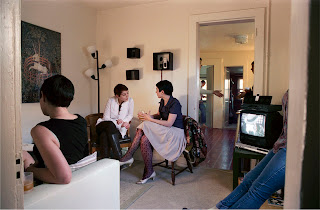
The photograph “Self-Socializing” explores this theme. Like the narrator of Company, who creates voices and characters in a world of fable only to find himself in the end “Alone,” this series exploits the role of photography in Beckett’s work in duplicating the self both for immediate comfort and to heighten a sense of solitude. Though “Self-Socializing” is populated in the manner of a cocktail hour, and lit with afternoon sunlight, certain images present in the room reaffirm the underscoring solitude of the subject. The caged unicorn, the turned off light fixtures, the camera on the wall, and Keaton’s face covered by his hands in a still of Film on the television, all point to lone activities and the entrapment of company. Only in the back of the frame, partially hidden by an arm but emerging from behind a door, does one see the true subject, alone, bewildered by the company she has created. Like the narrator of Company who only appears veiled in his devised reproductions, the photographer, not physically present in her duplicates, resembles them and hides behind their company. “How better in the end labor lost and silence,” she thinks, walking towards the scene.
Negation: The philosophy of ripping up pictures
Once duplicated into physical existence, the vision of the self, already fractured into multiple personalities, often ends in pieces. Of the few Beckett characters that encounter physical photographs, the majority of them tear the photos to bits in an attempt to undo representation and perhaps reject self-contemplation. In an act that destroys the imperfect signifier, the photograph, Beckett’s characters attempt to reinstate the unity of the sign, leaving the referent’s body itself, the object of the torn photograph, both signified and sole signifier. Whether intended to destroy the dangerously convincing artifice or its simultaneous announcement of absence, the characters with photographs place disproportionately great worth on the photographic power to signify. The failure of signs, the perception of self, and the loneliness of the duplicate all implicate themselves in the character’s destructive frustration.
Keaton’s Object character in Film tears up photographs of himself from different periods in his life, childhood to present, in his continued attempt to escape perception of others and avoid his own perception of himself. Krapp’s stopping and fast-forwarding of his tapes functions in a similar way: instead of destroying the image physically he destroys the voice temporally by scrambling the sound. Prose too accounts for episodes of photograph shredding. In Malone Dies, Moll flirtatiously gives a picture to Macmann, her love interest. “In the end Macmann tore up his photograph and threw the bits in the air, one windy day. Then they scattered, though all subjected to the same conditions, as though with alacrity.” The photograph of Moll is all the more dear to Macmann after she has died. He scatters her image as if it were the ashen remains of her body, yet the pieces fly away “with alacrity” and he is almost joyful to have done so. Often, characters react strongly to the represented presence of an absent object.
On the other hand, Beckett’s texts and characters commonly reject any mimetic representation, especially one that stresses absence in the first place. The set of Endgame, for example, contains a framed picture, face turned to the wall. If Endgame can speak for Beckett’s texts in general, the rejection of a representational image points only to the pain of knowing its absence. Beckett magnifies the absence of the referent seen in photography to a global scale in the play. Trapped in a building set in the middle of a wasteland which Clov describes as “Zero,” the characters witness even in the course of the play a gradual dying out of things, of referents. Hamm runs out of painkillers; Nagg has no more biscuits; Clov exterminates a flea and attempts to kill a rat. The world of these characters multiplies tenfold the absence felt in the photograph. Since everything is already absent—bicycles, forests, Turkish delight—one more reminder of absence only makes the room more barren.
A kind of ceremony accompanies all the examples of defacing pictures, as if they were made only to be destroyed. Keaton sits down to look at photographs he withdraws from a folder and one by one rips them in half twice. Krapp sits down at his desk to listen to his tapes, knowing he’ll have to stop them at certain moments. Clov never mentions the reversed picture on the wall and we assume its reversed status is normal. Macmann attends the scattering of Moll’s image with a poetic sensibility and an almost religious duty. The regularity with which characters destroy photographic signs testifies to their power to represent clearly and also the pain of their distance from the true referent.

“The Last Autoportrait,” my series of twelve photographs, examines the ritual nature of duplication, recognition, trickery, and destruction in Beckett as an example of the cycle of creation and destruction that all signs are put through in his work.
In a setting that resembles Krapp’s desk, lit with a single light in general darkness, I examine old self-portraits one by one. I order them, recognize myself in them, realize the absence of the different periods of my life in which they were taken, and then tear them up, and put them back into their envelope. Though the destruction of signifiers results from a desire to remove the duality and reinstate the purity of the sign, scenes of destruction always come as signs in a language. Like writing, “Say bones but no bones,” the revelation of absence and falsehood in words and photographs comes only after their initial meaning has been automatically inferred. Because he is always serving a faulty system of signs, the artist’s attempt to expose that system only works because of the systematic nature of a visual or written language. Attempting to suggest through language that words are without referents or through pictures that photographs do not show what they seem is as ironic as suggesting through a series of self-portraits that all self-portraits should be ritually destroyed.
Samuel Beckett: Advocate for Interdisciplinary Criticism
Judith Weschler proposes, “Perhaps illustration is the kind of interpretation¬––without criticism or verbal commentary––that Beckett could countenance.” Even though this statement highlights her misconception about the visual’s lack of critical power, it signals an important move towards interpretation of Beckett’s work in a non-verbal medium.
Though Beckett was known to encourage readers’ varied interpretations, saying, “If that’s what you believe, good for you,” when confronted with the supposedly objective word of the critic, pinning down the absolutes of meaning, he rejects explication. Perhaps one of the most remembered encounters between author and critic was between Beckett and Theodor Adorno at Frankfurt in 1961. They met in a café to lunch along with their German publisher Siegried Unseld, whose publishing house, Suhrkamp, was being honored that night. Speaking about an essay on Endgame he was to present that evening at the reception, Adorno explained to Beckett his theory about the etymology of names in the play, particularly “the derivation of ‘Hamm’ from ‘Hamlet.’” Beckett replied simply, “Sorry, Professor, but I never thought of Hamlet when I invented this name.” Somewhat uncharacteristic for the reader-response-friendly Beckett, this comment prompted Adorno to defend his view even more, leading to an unpleasant disagreement. An angered Beckett scoffed quietly to Unseld that night when Adorno read this part of his paper to the audience. “This is the progress of science that professors can proceed with their errors!”
This story is more than just another anecdote about the stereotyped debate between the self-serving critic and the proud writer, the mythology that separates the critical from the creative arts in the first place. Beckett refutes Adorno not as a writer, but as a critic himself, a skill he had refined over his years as a literature student at Trinity and throughout his early career as a reviewer. Of course Adorno could accuse Beckett of committing an “intentional fallacy” by suggesting what he “thought of” (or didn’t) while writing is important. Beckett, though, only rejects this one bit, without commenting on the rest of the essay’s discussion of “loss of meaning, identity, decline, and decay.” Because not all of Adorno’s interpretations irritated him, we know it wasn’t just a personal grudge, but that Beckett just disapproved of this certain method of reading. Regardless of the name’s origin, biblical, culinary, or Shakespearean, Adorno’s unwillingness to accept an alternate theory (and he didn’t; the reprinted essay retains the Hamlet etymology and has since been picked up by Harold Bloom) was the real problem. His overidentification of the text with a specific idea closes it down to a simple one-to-one equation: Hamm = Hamlet.
Adorno’s approach represents an entirely different discipline than that practiced by the various individual readers that tracked down Beckett himself to test out their own undergraduate theories. Notably, Beckett classifies Adorno’s mode of criticism as a “science” in which “errors” are corrected and “progress” made. Not to say that schools of criticism and theory don’t come and go, building upon one another in a semblance of progression. By seeing criticism as a “science” Beckett both compliments and insults the discipline, showing his faith in its potential credibility, yet thinking of it in terms of stale data and incorrect numbers. But, as Beckett knew from his own aphoristic opening lines, criticism is more an art of interpretation than a science of unlocking meaning. Beckett’s early critical commentary foresees the introduction of an artistic, especially visual, sensibility to criticism. Visual reinterpretations promote resemblance based on the whole rather than the part, thus addressing Beckett’s rejection of direct correlation and feeling for the ineffectiveness of verbal equations. The direct but fragmented correlation between the first three letters of Hamm and Hamlet robs each text of its independent whole, reducing each to a positivist critic’s relative amputations. A visual interpretation of Hamm as Hamlet, however, could be much less limiting.
“The danger is in the neatness of identifications.” The opening line of Beckett’s first published work (a work of criticism as it happens) exemplifies his multifaceted/creative approach to criticism. The first line of Proust reads, “The Proustian equation is never simple.” As if a foreword warning the reader of the impossible nature of the endeavor at hand, the fundamental problem of written criticism, these two first sentences champion (broad) understanding over precise semiotic equations. Adorno’s “Hamm = Hamlet” equation, for instance, is neat and simple, and therefore contradictory to Beckett’s own critical ideal. In these two early essays, a young Beckett searches for a mode of criticism that will not close down the text into an equation or dictionary definition. He looks for a way around the literal correspondence between the words of the critic and those of the artist.
The opening paragraph of “Dante…Bruno.Vico..Joyce” elaborates on the problem of ‘neat’ identifications: “[Vico] insisted on complete identification between the philosophical abstraction and the empirical illustration, thereby annulling the absolutism of each conception—hoisting the real unjustifiably clear of its dimensional limits, temporalizing that which is extratemporal. And now here am I, with my handful of abstractions…” Beckett recognizes here the parallel between Vico’s problematic philosophical identifications and his own forthcoming critical identifications. Beckett’s “And now here am I” underscores the irony of his own potential failure. The danger of ‘neat’ or complete identification is equally present to both philosopher and critic. The critic arrives at the text, with his “handful of abstractions,” ready to pin them to various episodes of the book, to create “complete identification” between text and abstraction.
In "Dante…Bruno.Vico..Joyce," Beckett does not pair his abstractions with “empirical illustrations” from Finnegans Wake, the subject of his essay. Instead, he refuses the direct identification typical of criticism, in favor of a broader view, thus preserving the “absolutism” (or integrity) of Joyce’s conceptions, Vico’s, and his own. “These two aspects of Vico have their reverberations, their reapplications—without, however, receiving the faintest explicit illustration—in Work in Progress.” Though he does, of course, give textual evidence for his findings, Beckett’s claim against “explicit illustration,” acts more as a reader’s guide to interpreting the essay, rather than a restriction on close reading. Instead of arranging piecemeal identifications, the critic rather relates the text in its entirety to the abstraction in its entirety. By keeping the text theoretically whole and in context, he refrains from “hoisting the real unjustifiably clear of its dimensional limits.” In other words, Beckett insists on the supremacy and the materiality of the text. The text is and is only the text, no gloss included, no assumptions made. The ‘absolute’ text lies outside critical commentary and (especially in the case of Finnegans Wake criticism) decoding. In a similar way, the critic’s own work, his ideas, retains its own ‘absolute.’ Rather than always playing backup to the subject of his study, the critic can create his own tune. Though the young Beckett was accused of ripping off his style from Joyce, his early essays have been remembered and revered more for their own distinct tone than for their canonization of Joyce or Proust.
Later in his career, Beckett finds the answer in images. Images, which are at once a reality in themselves and an indefinable abstraction, present the reader with a thousand more meanings than a set of words ever could. By introducing into his texts an extremely photographic set of images, Beckett suggests the critics too grab onto images more than just words as a way of understanding through pseudomorphic methods.
Predictably, Adorno, like Lessing before him, hated the idea of pseudomorphosis. “The moment one art imitates another,” Adorno writes, “it becomes more distant from it by repudiating the constraint of its own material, and falls into syncretism, in the vague notion of an undialectical continuum of arts in general.” Samuel Beckett, whose constant back-and-forth between drama, fiction, and television sets him against Adorno’s aesthetic preferences in the first place, gives one the sense that he simply wanted to express his ideas, which were conceived outside of any artistic discipline, with whatever medium best presented itself to him at the time. Rightly so, the same motifs recur throughout his work regardless of medium. Indeed, Beckett’s view of the arts seems to have been precisely as an “undialectical continuum,” with each art as imperfect and flexible as the next.
Photographs present a playing field for ideas and associations, a contained set of relationships onto which power dynamics can be mapped, a representation of reality, and yet a mere staging of a scene presented into the black box of the camera as a if a reenactment of a play in a space devoid of set; photography announces itself as significant play. Significant in its reference to a specific body’s reflection of light; play in its ability to convince the viewer to identify the subject as a surrogate for another. Beckett, an avid chess player, would have appreciated Flusser’s likening of the photograph to the black and white game: “a photograph is not a tool like a machine; it is a plaything like a playing card or chess-piece.” That is, a photograph can be used within a greater system of play to achieve an end. The photograph has no one single use, like the camera’s mechanical function to record light on film. Though the product of a machine, the photograph releases itself of empirical utility to play for whatever game chooses it. Beckett recognized early in his career the photograph’s potential
 play in visualizing texts when he asked that the cover of his novel Murphy bear a picture of two monkeys playing chess, with the caption, “What! You are giving up your Queen? Sheer madness!” Though no edition ever donned the image (though one should!), the photograph, which Beckett had seen in a journal as part of an advertisement, illustrates his awareness of the polysemous and flexible nature of what is often seen as a singular expression of a particular event. The institutionally white setting of the photograph suggests the mental hospital where Murphy works, and these two monkeys are undoubtedly Murphy and the patient Mr. Endon playing their habitual game of chess. Photography is no mode of illustration; it is instead a way of reconsidering relationships from a distance. Anthropomorphosing the monkeys into characters, the viewer simultaneously narrativizes the image into a story, attempting to fit it onto the novel as implausibly as the words “Sheer madness!” fit into a chimpanzee’s open mouth.
Photographs are of a reductive nature. From a greater whole they single out details, frame out the inessential, and illuminate necessities. In this same vein the critic concentrates the text into its most essential features projected onto a simple rectangles, pages or books, like those of the photograph. Overall, the practice of pairing photography with criticism opens possibilities of reading not present in linguistic analysis alone. In addressing Samuel Beckett’s textual images with an interdisciplinary approach similar to his own, the true nature of the work comes to light. This lies not in the specificity of linguistic connotation (Hamm=Hamlet) but in the more open and elusive relationship between textual and visual understanding where one image dramatizes a multiplicity of interpretations.
Afterword: The Critical Arts
Beckett’s work functions as mediator between the linguistic and the visual. In as much as he incorporated a visual approach into his written work, he served as a go-between for painting and poetry. Now, as the subject of many studies both critical and creative, Beckett’s work is a literal meeting-ground for critics and visual artists.
The beginning of an exchange of techniques in the arts, occurring in the mid to late twentieth century, when theory and photography came to incorporate aspects of the poetic language and painterly construction, coincides with Beckett’s own career and explorations. Though he could not be said to have single-handedly ushered in an era, his work was part of the movement towards dissolving the distinctions between the arts and the rules of how they had to function. His work itself reflects not the transfer of power to theory and photography, but rather the exchange of power between the different arts.
In a way, Beckett’s pseudomorphic approach reinstates the equality of the many arts after they had been sundered and ranked by the Renaissance writers, rephrasing Horace’s Ut pictura poesis as through a crystal, refracting the one statement into its many transformations as it applies to all the arts independently.
Today photographers like Jeff Wall join painters as pure creators. Theorists like Derrida present arguments as lively and poetic as the narratives commented upon. But regardless of how indecipherable they have come to appear, photography won’t become painting any sooner than criticism will replace literature. Though criticism and photography are not ‘poetry and painting,’ that canonized and mythologized pair, they are a form of art: imaginative, innovative, aesthetic. Because photography and theory as arts project an order onto preexisting elements, rather than constructing the elements themselves, I propose to call them the critical arts. Photography, no matter how painterly, always retains a special relationship to reality. Criticism, too, maintains its dependence on analytical thought derived from philosophy even though some modern theorists challenge it. Though they may appear under the guise of creative arts, for all intents and purposes these progeny will always retain the difference that led to their very birth.
Though photography is not one of the traditional visual accompaniments to criticism, it functions in a similar way. It carries the organizations of the graphed plot, web of characters, and map of diegetic location. Like these previously acceptable visual components of literary analysis, a photograph can do the same work and better in some instances. Photography’s flat rectangle, like that of the chart, orders contents into binaries and other logical groupings: hierarchies are displayed through gaze and composition, relationships established spatially in the frame. Like a map, a photograph can suggest setting through either a display of photographed locations or through a show of situations related to the story. Both contextualize the diegetic space. Though photographs made to accompany this essay do not compare in renown to those of masters so often used to illustrate theory’s ideas, but they do act as a demonstration of principles of photography that can be applied to literature and as an embodiment of the theory of pseudomorphosis. Photographs rightly accompany criticism not only in this specific context but also more broadly, in light of the movement towards embracing “graphs, maps, and trees” in studying literature.
I certainly do not feel compelled to remain within the borders of the literal because Beckett himself had no special relationship with photography; it was rather painting and film that inspired him. Numerous paintings are referenced in detail in his work and, when he was younger, he famously wrote to Sergei Eisenstein inquiring if he might be taken on as an apprentice of film. Regardless of biography, his thoughts, words, and images are of the same sensitive and dubious material as the photograph. And, as we have seen in the reverse logic of photographs, perhaps the absence of a specific medium may in fact point to its very presence.
All photographs present the viewer with, if not a narrative then at least the desire to create a narrative. As such, photography is a critical method. Editing, framing, focusing, and ordering are all abilities of the critic. The photograph, says Stephen Shore, is more than simple illustration and more even than creation: “an illustration is aiming the camera at the direction of some content, while the photograph is making sense of it.” Thus the photographer, like the critic, translates information, life or literature, into, if not a more comprehensible language, then at least an understandable gestalt.
By opening criticism to visual language one can curtail overly simple verbal equations. The task of translating the work from one medium to another (from text to image in my case) allows the piece to maintain total control over the reader in one medium, while inviting exploration and critique in another. Addressing the text in what Beckett calls “the absolutism of its conception,” offers critics an alternative to reductionist readings.
This approach seems to falsely assume the text itself is in danger of being destroyed by critics and deserves its status as untouchable––certainly not. In fact, the most written-about texts, Beckett’s included, continue to generate new discourse of their own accord. I only present a form of criticism more suited to an aesthetic akin to the text, suggesting by the way that perhaps the reader ought to engage the text with a mentality similar to the one with which it was written. This conceptual--rather than historic—recontextualization multiplies meaning and allows the text continued life. As critics, we want to reframe. As photographers, we dissect only with a lens.